
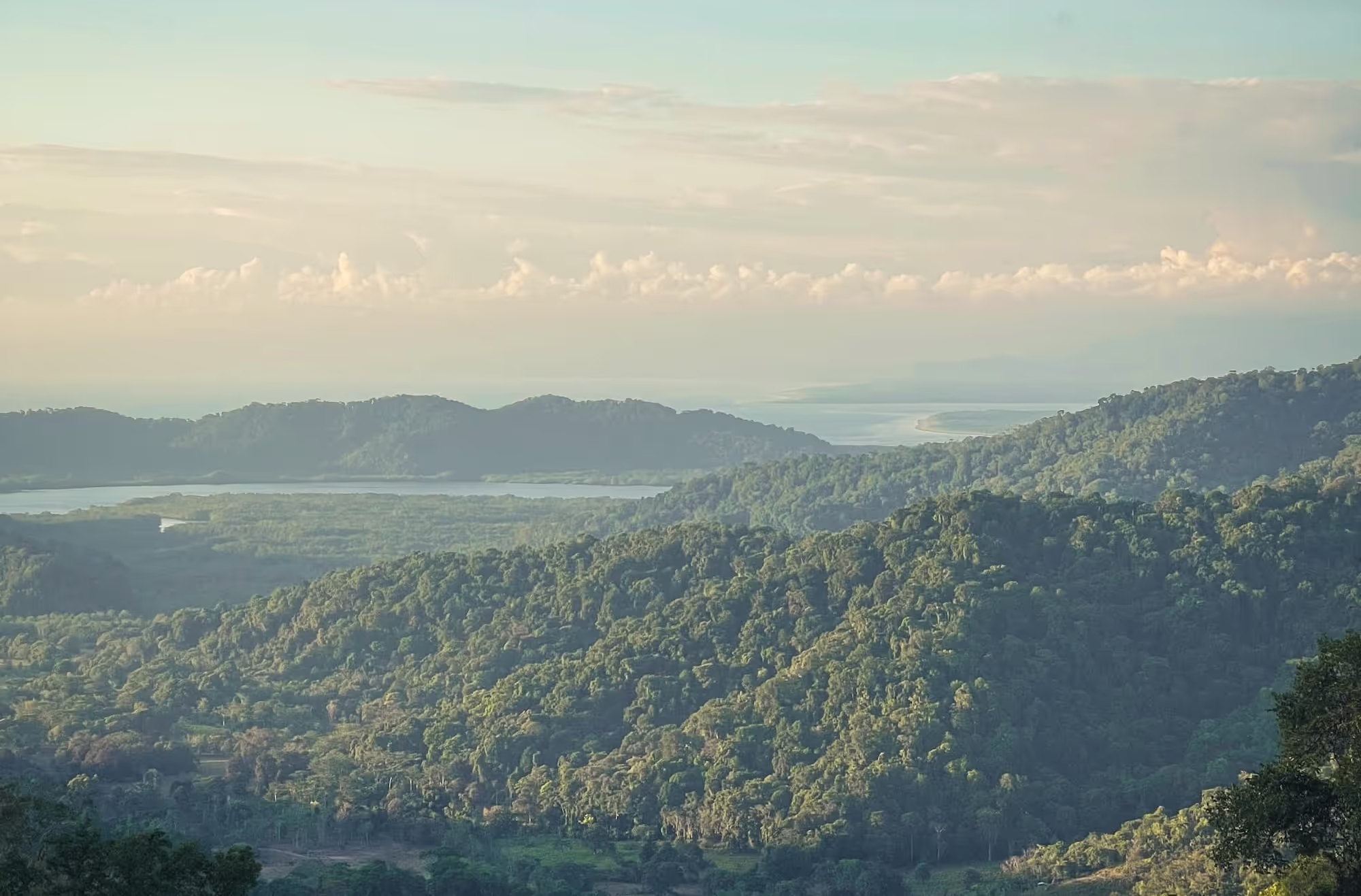
If you are looking to buy land in Costa Rica with the intention of protecting it, rewilding it, or building something meaningful on it, one region comes up again and again in serious conversations: the Osa Peninsula.
It is not hype. The Osa is one of the last places on Earth where large, contiguous tracts of biologically intact forest are still available for private purchase. It is also a place where buying property in Costa Rica is, with the right guidance, a clear and legally secure process.
This article explains why the Osa consistently attracts buyers who want more than a holiday home. Whether you are planning a private nature reserve, a regenerative retreat, a research station, or a residence surrounded by primary forest, here is what makes this region worth your attention.
1. The Osa Peninsula holds approximately 3% of the world's biodiversity
Costa Rica occupies roughly 0.03% of the planet's surface. Within that already exceptional country, the Osa Peninsula is the most biologically intense corner. The region around Corcovado National Park is estimated to contain approximately 3% of the world's total biodiversity, a figure cited by the National Geographic Society and consistent with scientific literature on the area.
What that means on the ground: scarlet macaws, tapirs, four species of monkey, jaguars, pumas, and hundreds of tree species coexist in a landscape that still functions as a fully intact tropical ecosystem. The Osa is one of the only places in Central America where this level of ecological completeness exists on land that can be privately owned.
For buyers who want their conservation land to carry real ecological weight, that biodiversity baseline is the starting point. You are not restoring a degraded pasture. In most cases, you are protecting or connecting forest that is already functioning.
2. Private wildlife refuges in Costa Rica have formal legal status
Costa Rica's Ley de Conservación de la Vida Silvestre (Law 7317) establishes three categories of national wildlife refuge: state-owned, mixed, and private. Under this framework, landowners can apply to the Dirección General de Vida Silvestre to have their property classified as a private wildlife refuge (refugio de vida silvestre privado).
Once classified, any development or extraction of natural resources within a mixed or private refuge requires prior authorisation from the Dirección General de Vida Silvestre, granted on conservation and sustainability criteria following a technical impact evaluation. Properties registered under this status are also exempt from territorial property tax under Article 87 of Law 7317.
This is a defined legal instrument grounded in national legislation, not an informal commitment.
Buy Wild works with partner attorneys who specialise in this classification process and in the broader due diligence required when acquiring conservation property in Costa Rica.
3. Large contiguous conservation properties are still available on the Osa
In most parts of the world, the window for buying large, intact blocks of tropical forest on private land has closed. On the Osa, it has not.
Properties of 50, 100, 200, or more hectares still come to market, typically held by families who acquired them a generation or more ago. Many sit directly adjacent to Corcovado National Park, creating the possibility of meaningful buffer zone conservation on land that connects to one of the most protected ecosystems in the Americas.
This availability reflects both the Osa's relative remoteness and the demographics of its landowners: families at a generational transition point, often with no clear succession plan for land that has been only lightly used. The properties that reach serious buyers today are the ones that still carry ecological integrity.
Buy Wild focuses specifically on this segment of the market. The platform was built for buyers who want to buy land in Costa Rica at a scale and quality that is genuinely useful for conservation, not just symbolic.
4. Foreign buyers have full property rights under Costa Rican law
Foreign nationals have the same property rights as Costa Rican citizens when buying property in Costa Rica. There are no restrictions on foreign ownership of fee-simple titled land. Title is recorded in the Registro Nacional, the country's centralised and publicly searchable property registry.
The due diligence process is what requires attention. Ownership discrepancies, servitude questions, and boundary disputes are the most common complications in rural properties. On conservation land specifically, verifying that the registered owner matches any PSA contract signatories, and confirming there are no encumbrances tied to environmental services agreements, is a step that should never be skipped.
Buy Wild's partner attorneys handles this verification as part of a structured legal due diligence service. The field audit covers the ecological and physical assessment of the property.
On the tax side: Costa Rica property tax on titled rural land is assessed at 0.25% of the registered municipal value, which typically sits well below market value. Private wildlife refuges are also exempt from territorial tax under Law 7317, as noted above.
5. Building on conservation land is possible with the right planning
A common misconception is that buying land for conservation means forgoing the possibility of building on it. In practice, Costa Rica's planning framework allows for residential or low-impact lodge construction on private land, including land with conservation status, provided the project goes through the relevant municipal and SETENA environmental permitting processes.
Many buyers on the Osa combine both objectives: a residence or ecolodge on a defined portion of the property, with the remainder under formal conservation management. This model tends to produce durable outcomes precisely because the landowner is present, invested, and on the ground.
The key is engaging the right professionals from the start. The permitting path, zoning, SETENA environmental approval, and the municipal building permit, is well established in Costa Rica. What matters is having architects and legal advisors who handle Osa projects regularly, since local requirements may vary by municipality. Buy Wild can connect buyers with architects and legal advisors who know this regulatory environment well.

6. The property tax and cost structure favours long-term conservation holding
Holding conservation land in Costa Rica carries a low annual cost relative to comparable land in other tropical countries. Property tax is set at 0.25% of the registered municipal value, which is assessed independently of market value and is typically a fraction of what the land would sell for. Private wildlife refuges are additionally exempt from territorial tax under Law 7317.
There is no capital gains tax on real estate in Costa Rica for most individual sellers, and the transfer tax at the time of purchase is 1.5% of the registered value. These conditions make long-term holding genuinely affordable, which matters for conservation buyers who are not planning to sell.
7. Buy Wild gives you professional support on both the conservation and real estate side
Buying conservation land in a foreign country requires two distinct types of expertise: knowing the land, and knowing the legal and commercial process. Most real estate platforms offer one or the other. Buy Wild was built to provide both.
On the real estate side, Buy Wild operates with a structured contract framework that governs every transaction. The platform focuses exclusively on ecological and conservation properties, which means the listing inventory has already been filtered for the right land type.
On the conservation side, Buy Wild offers a property field audit service: an on-the-ground ecological assessment of any property before you travel to view it. A field expert visits the site, evaluates the forest type, wildlife indicators, terrain, water sources, and boundary condition, and delivers a written report, annotated map, and drone video within five business days. The purpose is to give serious buyers the information they need to make a decision before committing to a trip from Europe or North America.
This combination, real estate professionals who understand conservation land and conservation professionals who understand the transaction, is what distinguishes Buy Wild from a general property portal.
Is the Osa Peninsula right for your project?
The Osa is not for every buyer. It is remote, it is humid, and properties there require ongoing management to remain in good ecological condition. For buyers who are serious about conservation land in Costa Rica, those same characteristics are precisely the point.
If you are evaluating whether this kind of investment makes sense for you, the right first step is a conversation with a team that knows the region and the process. Buy Wild works with buyers at every stage, from initial feasibility to closing.
Get in touch to discuss what you are looking for. We will tell you honestly whether what you are looking for exists on the Osa today.
Frequently asked questions
Can foreigners buy land in Costa Rica for conservation?
Yes. Foreign nationals have full property rights under Costa Rican law and can apply to register their titled land as a private wildlife refuge under Law 7317.
Read our article about foreigners purchasing properties in Costa Rica
How much does land cost on the Osa Peninsula?
Prices vary by size, access, forest quality, and proximity to Corcovado. Buy Wild can provide current market context for specific search criteria.
Can I build a house on conservation land in Costa Rica?
Yes, in most cases. Construction on private land, including land with conservation status, requires the relevant municipal and SETENA environmental permits. Many buyers combine a residential or lodge development with a formal conservation management plan for the wider parcel.
What is a private wildlife refuge in Costa Rica?
A formal legal designation under Law 7317 (Ley de Conservación de la Vida Silvestre) that classifies a private property as a protected wildlife area. Registration is processed through the Dirección General de Vida Silvestre and the status is recorded on the national property registry.
How does the Buy Wild field audit work?
Buy Wild sends an ecological expert to assess a property before you travel. Deliverables are a written report, annotated map, and drone video, within five business days. It covers ecological and terrain assessment. Legal due diligence is a separate service available through Buy Wild's partner attorneys.
Contact Buy Wild to discuss your vision, your budget, and what the right property looks like for you.