

There is a reason Costa Rica consistently tops the list of destinations where wealthy Americans choose to invest in land. The country punches far above its weight: 0.03% of Earth's surface area, yet home to nearly 6% of its biodiversity. A stable democracy since 1948. Property laws that treat foreign buyers identically to local citizens. And a conservation culture so deeply embedded in national identity that protecting wild land is not just an ethical act, it is a financially sound one.
If you are looking for a large property in Costa Rica (a finca), a private nature reserve, a future ecolodge, or simply a piece of intact rainforest to steward, here are the five reasons why this is the right country, and why now is the right time.
1. You own it outright: The same rights as a Costa Rican citizen
The single most important question any foreign buyer asks: can I actually own this?
In Costa Rica, the answer for titled land is an unambiguous yes. Foreigners enjoy "fee simple" ownership on titled land, which means they have the exact same property rights as Costa Rican citizens, including the right to sell, rent, develop, or pass property to heirs.
No residency requirement. No local partner. No expiration date on your ownership.
You do not need to live in Costa Rica to own property. Many foreign investors purchase land without living in the country full-time. You can buy, hold, and manage your property remotely, and thanks to Costa Rica's transparent National Registry, title verification is straightforward.
This legal security is not an accident. Costa Rica has maintained one of Latin America's most stable democratic governments since abolishing its military in 1948, redirecting those resources into education, healthcare, and environmental protection. That stability is baked into the real estate market. For buyers of conservation land or large rural properties where long time horizons are the norm, this matters enormously.
The one exception to know: beachfront properties within the Maritime Zone (the first 200 meters from the high tide line) are subject to concession rules that limit foreign ownership. For inland forest properties and fincas, the core of what Buy Wild specializes in, this restriction does not apply.
2. Property taxes are among the lowest in the Americas
Holding costs matter, especially for large rural properties you intend to conserve rather than develop. Costa Rica's tax structure is strikingly favorable. The annual property tax is set at a flat 0.25% of your property's registered municipal value, a rate codified in law and applied uniformly across all 82 municipalities. On a $500,000 property, that is $1,250 per year. In practice, the registered municipal value typically runs 30 to 50% below actual market price, meaning your real tax bill is often even lower than that.
There is a second tax layer worth knowing: residential properties with a construction value above approximately $250,000 are subject to a progressive luxury tax ranging from 0.25% to 0.55%. But for Buy Wild clients, this is largely irrelevant. Bare land, agricultural land, and conservation properties with no legal dwelling are fully exempt. If you are buying a finca or a forested tract to protect and restore, you pay the base 0.25% on the registered value, and nothing more.
Finally, if your land qualifies for Costa Rica's Payment for Environmental Services (PES) program, which pays landowners directly for maintaining or restoring forest cover, those annual payments can offset your holding costs entirely. In effect, the net cost of owning and protecting wild land in Costa Rica can approach zero.
3. The land itself is extraordinary and getting rarer
Costa Rica is one of the last places on Earth where you can still buy large tracts of intact or recovering tropical rainforest at accessible prices. That window is closing.
Costa Rica is a world-renowned trailblazer in conservation. Today, more than 25% of the country's land is protected within national parks, private reserves, and wildlife refuges. But that also means the remaining privately held wild land is increasingly scarce and increasingly valuable. Both ecologically and financially.
The Osa Peninsula, where Buy Wild focuses its work, is the crown jewel. Adjacent to Corcovado National Park, described by National Geographic as "the most biologically intense place on Earth", Osa Peninsula properties sit inside active biological corridors where jaguars, tapirs, scarlet macaws, and all four species of Costa Rican monkeys still move freely. Buying land here is not just purchasing property; it is entering one of conservation's most important frontiers.
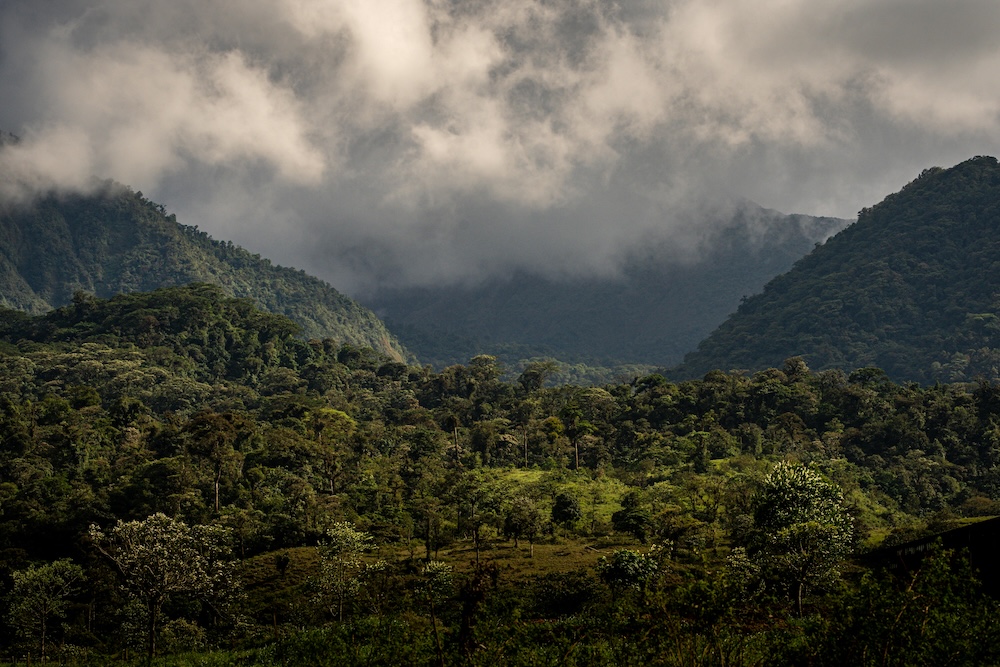
Destinations like the Osa Peninsula lead the country in high-value pricing, and for good reason: land adjacent to protected areas, inside biological corridors, or with intact primary forest commands a premium that will only grow as these parcels become rarer. Conservation land in Costa Rica is one of the few asset classes where financial appreciation and ecological value move in the same direction.
4. A country built around conservation, and it pays
Costa Rica's commitment to the environment is not marketing. It is law, infrastructure, and national culture.
Through the implementation of the Payment for Environmental Services program, Costa Rica has facilitated significant tree planting efforts and supported forest conservation across vast areas of the country.
The country reversed catastrophic deforestation (forest cover fell to around 20% in the 1980s and has since recovered to over 50%) through a combination of private landowner commitment and government incentive programs that remain active today.
For conservation-minded foreign buyers, this means you are not working against the system. You are working with it. Costa Rica's SINAC (National System of Conservation Areas) actively supports foreign landowners who want to register their properties as private nature reserves. The national network of private reserves (the Red Costarricense de Reservas Naturales Privadas) provides affiliation, recognition, and access to additional programs.
No other country in Central America offers this combination: strong legal protections for foreign landowners, active government conservation programs, a global reputation that attracts research institutions and NGOs, and land that is genuinely, irreplaceably wild.
5. The market is mature enough to trust and still has room to grow
Costa Rica's real estate market for foreign buyers is not a frontier experiment. It is a well-established, transparent market with a track record stretching back decades.
In the last 20 years, Costa Rican real estate has seen steady appreciation. With the number of tourists increasing and no ownership restrictions, there has been strong demand for property and experts agree that appreciation will continue.
Costa Rica welcomed over 2.6 million international visitors in 2024, a 10% increase on 2023. That sustained tourism flow underpins the economic case for conservation land with ecotourism potential: ecolodges, nature retreats, and wildlife experiences remain some of the fastest-growing segments of the global travel market.
For large conservation properties specifically, the supply-demand dynamic is particularly favorable. Despite growth, the most desirable lifestyle markets remain supply-constrained. There are simply not many large, biodiverse, legally titled properties adjacent to protected areas left on the market. Those that do come available tend to sell to informed buyers who understand what they are buying. That is exactly where Buy Wild comes in.
Why Work With Buy Wild?
Most real estate agents in Costa Rica, however competent, are generalists. They sell condos, beach houses, and vacation homes. Buy Wild is different.
We specialize exclusively in large properties in Costa Rica's most biodiverse region: the Osa Peninsula. Our focus is conservation-minded buyers. People who want to protect land, restore ecosystems, create private nature reserves, or build sustainable ecolodges. We are not just realtors in Costa Rica. We are conservation partners who happen to know every significant property in our region.
When you work with Buy Wild, you get:
- Curated listings of large fincas and conservation properties adjacent to Corcovado and the Osa's biological corridors
- Expert guidance on what each property can become, its reforestation potential, wildlife value, and conservation strategy
- A network of local partners including rangers, native plant nurseries, architects, and legal specialists
- Dedicated programs for reforestation, wildlife monitoring, and land management so your property starts working from day one
The right Costa Rica real estate investment is not just about the land. It is about knowing what to do with it. We help you with both.
Ready to find your property in Costa Rica?
Contact us to get access to our current listings. Whether you are at the early research stage or ready to move quickly on the right opportunity, we are here to help you find a property that matches your vision and make it everything it can be.